
Don’t just take their word for it: a transparent way to assess corporate climate plans
Community Insights series
The Smith School's Community Insights series features up-to-the-minute and incisive commentary from leading voices outside of academia, including from our Board, business fellows and partners.
Dr Gireesh Shrimali is the Head of Transition Finance Research at the Oxford Sustainable Finance Group and the Technical Lead in the Secretariat for the UK Transition Plan Taskforce, established by HM Treasury in 2022.
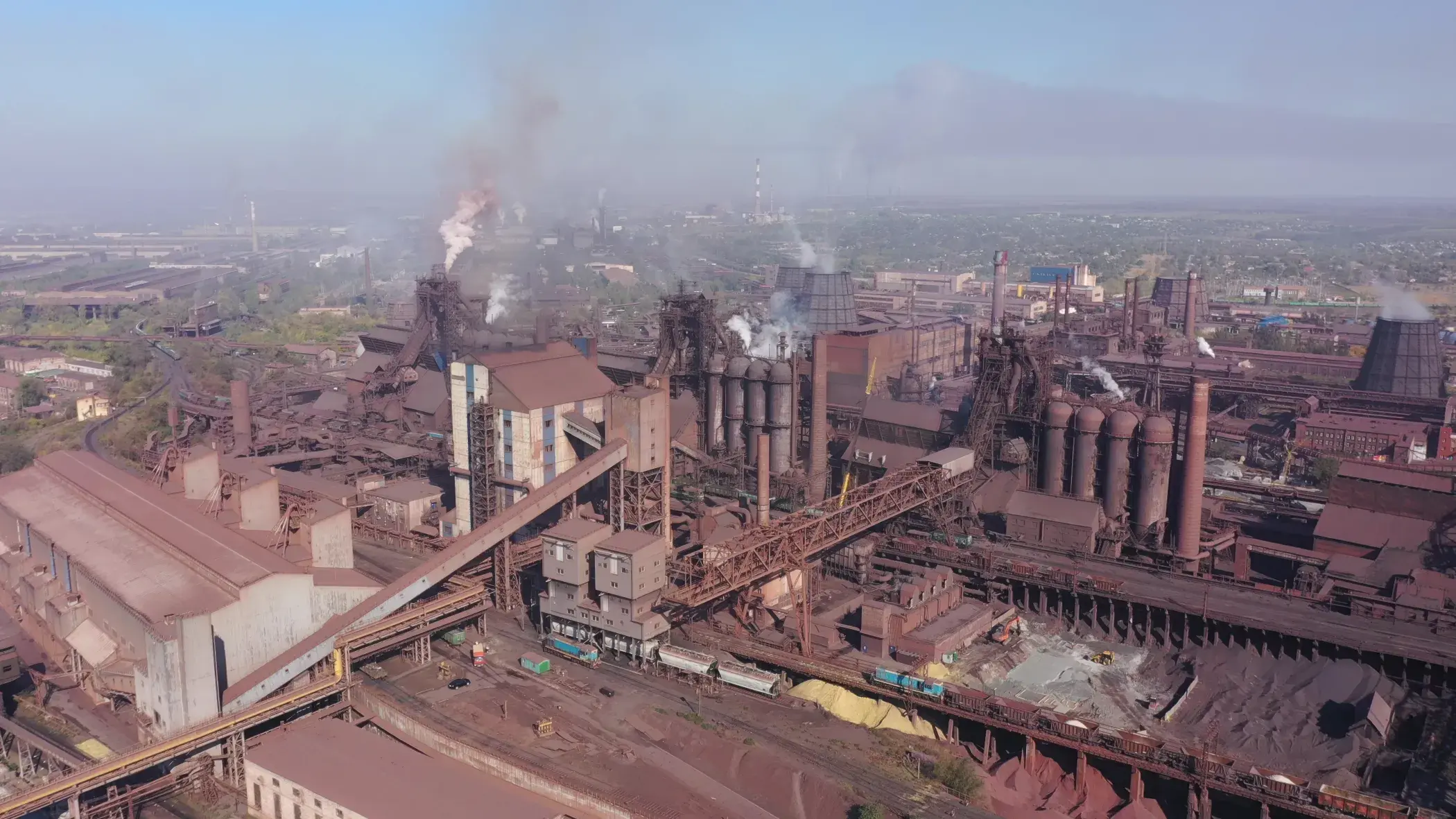
An open-source method estimates a company’s future emissions from its actual production plants, even when the company won’t tell you.
Over the past two years, some of the world’s biggest polluters have quietly walked back their climate promises. Steelmaker ArcelorMittal, for example, cancelled its plans to convert two German steel plants to greener production in 2025 even though EUR1.3 billion in state subsidies were on the table. Around the same time, the EU moved to scrap a rule that would have forced large companies to publish credible climate plans at all.
These “transition plans” are a company’s public statement of how it intends to cut its greenhouse gas emissions over the coming decades: which coal plants it will close, which factories it will upgrade, which clean technologies it will adopt and by when. Investors, regulators and campaigners increasingly treat them as an important indicator of whether a company is serious about climate change.
But this raises an important question: how do we know whether these plans are credible? Almost every existing method for checking transition plans leans, directly or indirectly, on the emissions figures and plans the company reports about itself. In 2025, 73% of the US companies asked to report a transition plan to CDP – widely seen as the gold standard of emissions disclosure – did not do so, and most of those that did left gaps. Because firms count their emissions in different ways, even the disclosure of two companies in the same industry often can’t be compared. In short, we have been examining companies’ climate performance using answers the companies wrote themselves.
A different starting point: the physical assets
In a new paper in Nature Communications, we set out a way around this problem. Instead of starting from what a power or steel company says about its emissions, we start from what it physically owns and operates: the power plants, the blast furnaces, and the steel mills. We call it the asset-based planning approach (APA), and it is fully open-source. This means that every assumption and data point is published for anyone to check.
The logic is simple. A given power plant or blast furnace emits a fairly predictable amount of CO₂ for each unit of electricity or steel it produces. Drawing on independent, publicly available datasets – such as those from the Spatial Finance Initiative and Global Energy Monitor – we build a complete production profile for each company and estimate its direct emissions from the bottom up, using the same standardised rules for each company so that the results are comparable.
Crucially, the method also looks forward. Industrial assets have a known economic lifetime, so we can model when each asset will wear out and need replacing or retiring, and what each company’s emissions will look like decades ahead, with or without its cooperation to disclose a transition plan. In case a company discloses a transition plan, we can then layer in a company’s stated plans and see what difference the planned actions to reduce emissions make. If a steelmaker says it will shut a European blast furnace in 2029 and install cleaner direct-reduced-iron and electric-arc-furnace technology instead, APA estimates by how much that upgrade would cut its total emissions.
What we found: The results are sobering
We tested the method on 20 of the world’s heaviest-emitting companies: ten electric utilities and ten steelmakers. The headline results are sobering. Of these companies, only three had plans broadly compatible with a Paris-aligned carbon budget: the three steelmakers SSAB, POSCO and ThyssenKrupp. Not one of the ten power companies had a plan that got them there.
And we were very generous. We took every company’s promise at face value and assumed that green hydrogen – a technology still far from being available at scale – would be commercially available and used in steelmaking by 2030. These are best-case numbers and do not say anything about the likelihood that companies would implement those plans. So, the reality is likely to be worse. Indeed, since we finished collecting the data, several steelmakers, ArcelorMittal and ThyssenKrupp among them, have already backtracked. This means that our most optimistic assessments are probably outdated already.
Two companies show how the trouble hides in detail. The Italian utility Enel’s plan would roughly halve its emissions compared with carrying on as usual, yet it still blows past every carbon budget we tested. ArcelorMittal’s plan barely moves the needle (a 11% cut), not because it isn’t planning to build cleaner capacity in Europe, but because those gains are swamped by a huge expansion of conventional, high-emitting steelmaking capacity through a joint venture with Nippon Steel in India.
That points to the deeper risk we set out to capture with APA: carbon lock-in. When an old furnace or power plant reaches the end of its life, a company faces a fork in the road – refurbish it and lock in another two to four decades of emissions, or switch to something cleaner. We estimate that 42% of the steel assets and 12% of the power assets in our sample will hit that point before 2030. The choices made in the next few years will shape emissions for a generation.
One more finding matters for anyone using these assessments: the answer can depend on which climate model you benchmark against. Two of the three “aligned” steelmakers only pass under the most lenient integrated assessment model. That makes transparency essential and means companies should not be allowed to cherry-pick the friendliest scenario to declare themselves Paris-aligned.
Why this matters most where disclosure is weakest
The real power of starting from physical assets is that it flips the burden of proof. Until now, a company could hide behind incomplete disclosure. With an open method that works without its cooperation, the onus shifts: if a company thinks our assessment is wrong, it can prove it by disclosing better, audited data. That is useful everywhere, but it is most valuable precisely where corporate disclosure is thinnest, which often means the fast-growing economies of the global South.
India is a case in point. Its disclosure regimes are ramping up fast: the market regulator SEBI now requires the top 1,000 listed companies to file Business Responsibility and Sustainability Reports (BRSR), with a “BRSR Core” set of metrics (including greenhouse gas emissions) that must be independently audited. The central bank, the RBI, has introduced a framework for disclosing climate-related financial risks that is phasing in for banks and other regulated lenders from 2025-26. Yet, as in the rest of the world, this information is still patchy, inconsistent and largely self-reported.
This is where an independent yardstick earns its keep. A tool like APA would let SEBI scrutinise whether a listed company’s stated transition plan is physically plausible and let the RBI and Indian banks gauge the transition and stranded-asset risk sitting in their loan books, without having to wait for perfect disclosure. Our sample already includes Indian heavyweights such as NTPC and Tata Steel, but our method could easily be extended to cover all companies in the power and steel sectors in India. It can even be expanded to other high-emitting sectors with stationary production assets, if asset-level datasets are available.
But there is a fairness problem with judging an Indian company by the same global benchmark as a European or US American firm. India has contributed far less to the historical emissions now driving climate change. Applying a global yardstick risks penalizing companies in India and other countries in the global South because our benchmarks account for the fact that these companies may have relatively larger shares of the remaining global carbon budget than their Western competitors. That is why the real question is what a fair share of the remaining carbon budget looks like for them.
That is why we have extended the method in a follow-up paper, currently under review, to build in the principle of common but differentiated responsibilities. This lets us assess companies in countries like India against equity-adjusted benchmarks, rather than a one-size-fits-all global line, making the approach useful both for regulators holding companies to account and for a transition pathway that is seen as fair.
Our APA method is also built to scale. It can be applied to other heavy-emitting sectors – such as cement, petrochemicals, aluminium, upstream oil and gas – and we are now exploring how AI can help to partially automate the data integration work, so assessments can cover far more companies and be updated regularly as new information on companies’ operations becomes available.
Transition plans are only as good as our ability to check them. APA is the most robust method to check them in a transparent manner and to hold companies accountable to reduce emissions whether they tell us how they plan to do so or not.
Community Insights series
The Smith School's Community Insights series features up-to-the-minute and incisive commentary from leading voices outside of academia, including from our Board, business fellows and partners.
Dr Gireesh Shrimali is the Head of Transition Finance Research at the Oxford Sustainable Finance Group and the Technical Lead in the Secretariat for the UK Transition Plan Taskforce, established by HM Treasury in 2022.