
MSc SEE student Justice Appiah Nuamah named one of eight global Energy Leaders for Tomorrow
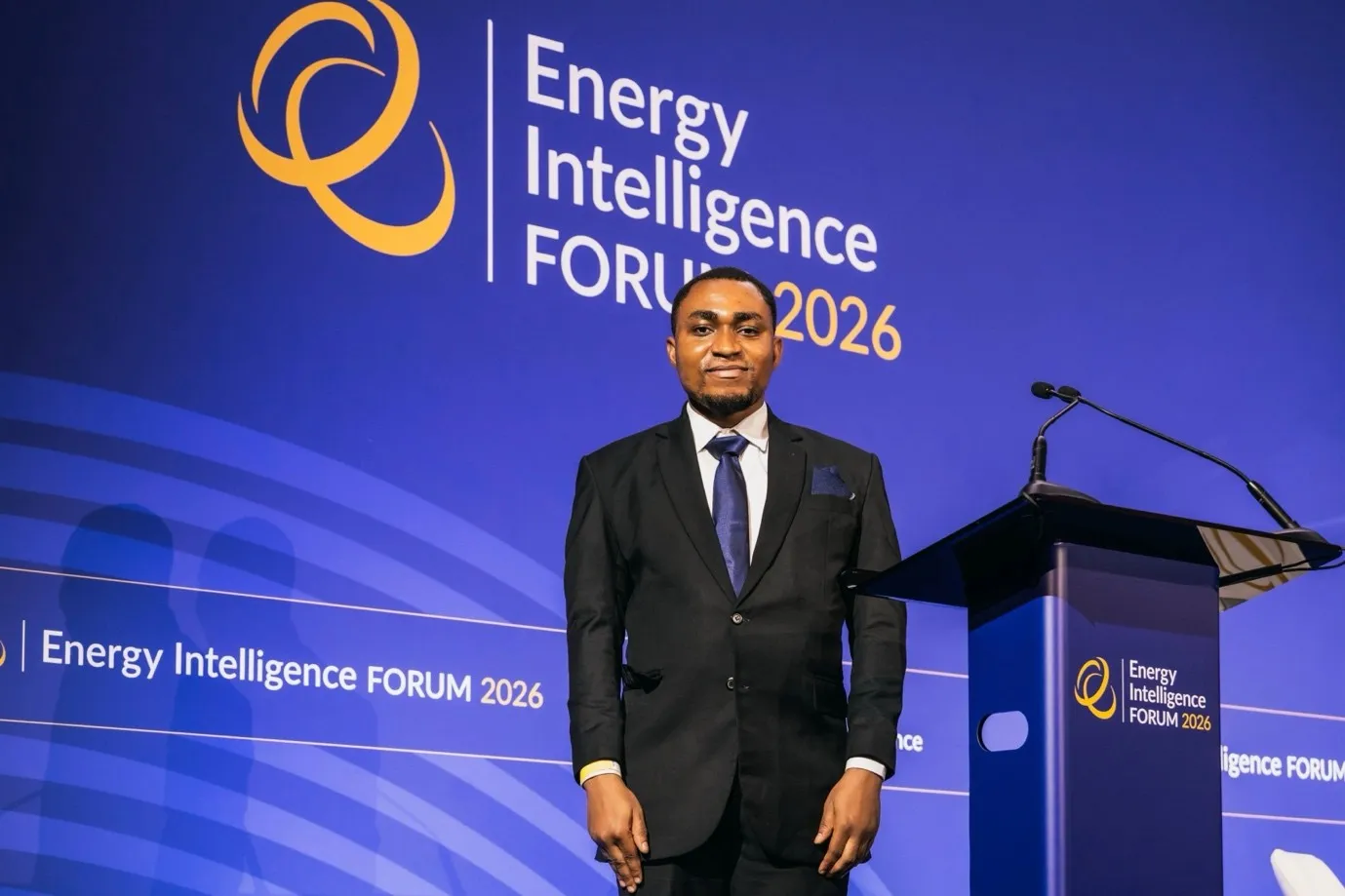
Justice Appiah Nuamah, a Mastercard Foundation Scholar studying at Oxford’s Smith School, at the Energy Intelligence Forum 2026 in London. (Image Copyright: Energy Intelligence Forum)
Just weeks into his Smith School MSc, Mastercard Foundation Scholar Justice Appiah Nuamah has been presented on stage in London as one of the world’s most promising emerging energy leaders.
Justice Appiah Nuamah is studying for an MSc in Sustainability, Enterprise and the Environment (SEE) at the University of Oxford’s Smith School of Enterprise and the Environment, and he has already been recognised on a global stage. A Mastercard Foundation Scholar and Oxford-Reuben Scholar at Reuben College, Justice is one of eight 2026 Energy Leaders for Tomorrow selected worldwide by Energy Intelligence.
The programme identifies eight top graduates who have recently entered, or are about to enter, the oil, gas or new energy workforce. The awardees were presented at the 47th Energy Intelligence Forum in London on 5 and 6 October, before an audience of global energy CEOs, senior executives and political leaders.
The recognition is closely tied to Justice’s place in the Oxford community. A first-generation scholar, he is studying the MSc SEE at the Smith School, where Professor Sam Fankhauser, the School’s interim director, a Reuben Fellow and a professor on the course, was named the 2025 Energy Economist of the Year at last year’s Forum.
"We are delighted to welcome Justice to the 2026/27 cohort of our MSc programme. The programme brings together some of the brightest emerging minds in sustainability, and Justice perfectly exemplifies the talent, passion and leadership potential that define this exceptional group," said Professor Fankhauser.
“The connection between Africa Oxford Initiative, the Mastercard Foundation, the Smith School, Reuben and the Forum makes this a particularly special part of my Oxford journey,” says Justice.
Justice is also the first person from the University of Mines and Technology (UMaT) in Ghana to join Oxford as a Mastercard Foundation Scholar. A First Class Honours graduate in Petroleum Engineering, he has worked as a Process Engineer at the Ghana National Gas Company and, as a Graduate Researcher at Washington University in St. Louis, investigated advanced combustion processes for converting wood waste into energy while capturing the resulting CO₂ for geological storage.
“I am especially grateful to the Mastercard Foundation for the support that has made my Oxford journey possible,” he says. “Being able to begin my studies at Oxford and then take part in an international platform such as the Energy Intelligence Forum has been deeply meaningful to me.”
He hopes his story will show what investment in African scholars can achieve and encourage other young Africans to pursue opportunities on the global stage. “Being selected among eight emerging energy leaders globally is a meaningful reflection of the potential that AfOx and the Mastercard Foundation Scholars program invest in and seek to develop across Africa,” he says.
That potential is evident in his work, which sits at the intersection of conventional energy systems, carbon management and Africa’s energy transition. His interests include gas flaring reduction, combustion, carbon dioxide removal and practical pathways to energy security and net zero. As a COP30 Simulation Fellow, he authored one of the first integrated frameworks for deploying bioenergy with carbon capture and storage in Ghana. His earlier achievements include leading UMaT to victory in the 2021 Ghana Gas Challenge, receiving the 2024 McCall MacBain Regional Award for Sub-Saharan Africa, and being named one of 180 finalists from more than 8,000 applicants for the 2026 Knight-Hennessy Scholars Programme at Stanford.
At Oxford, Justice aims to explore how carbon dioxide removal and emerging energy technologies can contribute to achieving geologic net zero, alongside the policy and investment frameworks needed to bring these solutions to scale. He is particularly interested in applying algorithmic modelling to reduce gas flaring, redirect capital, and shape energy transitions around Africa's development priorities.
(This article appears here on the Smith School website in partnership with the Africa Oxford Initiative).
If you, as an individual or representative of an organisation, would like to be part of the journey of other future leaders like Justice, please visit our "support us" page, or contact directly our Alumni Communications Manager, Mark Randolph for more information: mark.randolph@smithschool.ox.ac.uk