
Turning commitments into capital: The next step for the Tropical Forest Forever Facility
Community Insights series
The Smith School's Community Insights series features up-to-the-minute and incisive commentary from leading voices outside of academia, including from our Board, business fellows and partners.
 Juliana Santos Oliveira is an Economist with an MSc in Sustainability, Enterprise and the Environment from the Smith School of Enterprise and the Environment, and a Weidenfeld-Hoffmann Scholar. Her experience is in capital markets, strategic consulting, and philanthropy advisory. Her interest is in the intersection of private capital and social and environmental action.
Within the climate and nature space, what interests me most is how, and whether, it is possible to get private capital into environmental goals. This interest shaped my MSc dissertation. In 28 semi-structured interviews with asset owners, intermediaries and climate finance experts, I examined the Tropical Forest Forever Facility and how its financial architecture creates the incentives needed to attract private capital. What follows sets out what I found.
At COP30 in Belém, the Brazilian Government launched this innovative conservation mechanism. The Tropical Forest Forever Facility (TFFF) aims to provide long-term funding for the conservation of tropical forests, paying USD 4 per hectare per year to Tropical Forest Countries that protect their forest cover. In a results-based system, the TFFF uses a blended finance mechanism designed to raise USD 100 billion from the private sector (Senior Capital) on the back of USD 25 billion in Sponsor Capital from governments and philanthropists.
The difference from previous mechanisms is not the blending itself, but how it is structured. The capital raised is allocated to an investment fund, the Tropical Forest Investment Fund (TFIF), intended to generate investment-grade returns. The payment waterfall pays senior capital first, at the Treasury rate plus a spread, then junior capital at the Treasury rate, with the surplus funding forest payments. By decoupling investor returns from conservation outcomes, the design responds directly to private actors’ complaint that nature investments carry too much risk for too little return.
Overview of the TFIF financial structure. The diagram shows the blending of senior debt and sponsor capital, the portfolio allocation from the Blended Finance Fund, and the distribution of payments to eligible forests. Senior debt, 80% of the total, comes from institutional investors and sovereign wealth funds; sponsor capital, the remaining 20%, comes from sovereign investors and philanthropies. A treasury manager pools both into a blended fund invested in a diversified bond portfolio rated BB+ on average. Returns repay senior and sponsor capital providers in turn, while the surplus, the TFFF yield, is disbursed to eligible tropical forest countries.
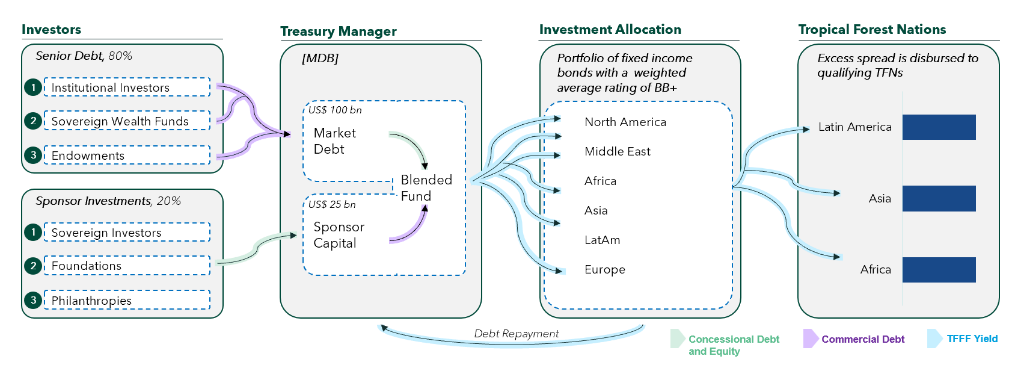
Source: Tropical Forest Forever Facility, Concept Note 3.1 (2025).
It is a genuinely original idea. The New York Times called it “an elegant idea” when it was first proposed, while Bloomberg called it an “audacious plan” that relies on an “unlikely saviour: Wall Street”. If the TFFF reaches its target, it would meaningfully increase the private sector's current, marginal role in global forest finance, which today supplies less than a tenth of the USD 84 billion a year the world spends protecting forests, against the roughly USD 300 billion the UN State of the World's Forests report identifies as the amount actually needed.
There are early signs of private investor interest. In October, 34 financial institutions signed the Rotterdam Statement of Support, welcoming the TFFF's progress. A statement of support is not a cheque, though, and none of the facility's goals will be met unless the senior capital it is counting on actually materialises. In that sense, the real challenge for the TFFF is not being recognised as innovative or relevant (both are already true). It is whether the design is aligned with the terms private institutions need to see before they commit capital to it.
The closer to the cheque, the more caution
Commercial attractiveness is the central hypothesis behind private investor engagement with the TFFF, and in theory it justifies the mechanism as a whole, since better-structured returns should be enough to attract private capital. Among my sample, the closer an institution sits to writing the cheque, the more cautious it becomes about risk and return. No asset owner, 40% of intermediaries and 29% of experts rated the return proposition as positive. The scepticism was driven mainly by opportunity cost. The TFIF portfolio's returns come from a basket of sovereign and corporate bonds that is, in practice, already available to any treasury desk, and several respondents asked why they should take on the operational and reputational overhead of a new, unfamiliar vehicle for exposure they could get more simply elsewhere.
Why would I pay the TFFF to go and build a portfolio of bonds that I could even just buy myself? I have a full trading floor that can do it for me. And I want the beta of the emerging market risk: this is diversifying. - Asset Owner No. 003
Among the 14 climate finance experts I interviewed, a second pattern emerged, one the original research design had not anticipated. Institutional proximity to the TFFF's own design process predicted optimism more strongly than stakeholder category did. Experts affiliated with multilateral development banks, DFIs or the UN were consistently more positive than independent consultants, financial advisories, and academics. For commercial attractiveness specifically, only 14% of MDB/DFI/UN-affiliated experts expressed a sceptical view, compared with 71% of independent experts. This shows that those closer to the capital allocation are less comfortable with the risk-return trade-off.
Looking across the full sample of attractiveness factors raised during the interviews, risk-return and fiduciary duty concerns were cited most often, by 13 of the 28 interviewees, well ahead of doubts about the TFFF's credit rating and subordination structure, raised by 7. On the other side of the ledger, government backing and the competitiveness of returns for the asset class were the two factors interviewees most often pointed to as reasons the TFFF could still win private capital over.
Respondents also pointed to something more structural beyond scepticism about the return itself. Private capital markets, as several put it, are simply not built to reward this kind of investment. Fiduciary duty, the obligation asset managers carry to maximise risk-adjusted returns for their clients, was the single most frequently cited constraint in the whole sample. That obligation is reinforced by how asset managers are typically remunerated, based on maximising returns rather than on environmental outcomes, inside a voluntary system that carries no regulatory requirement for large asset owners to hold sustainability-linked assets.
The private sector, unless the international policies change, will invest wherever they make money. They don't invest to conserve the public commons. It's not their function. - Climate Finance Expert No. 014
Frequency of attractiveness factors and barriers raised when discussing commercial attraction. Share of the 28 interviewees raising each factor. Not mutually exclusive.
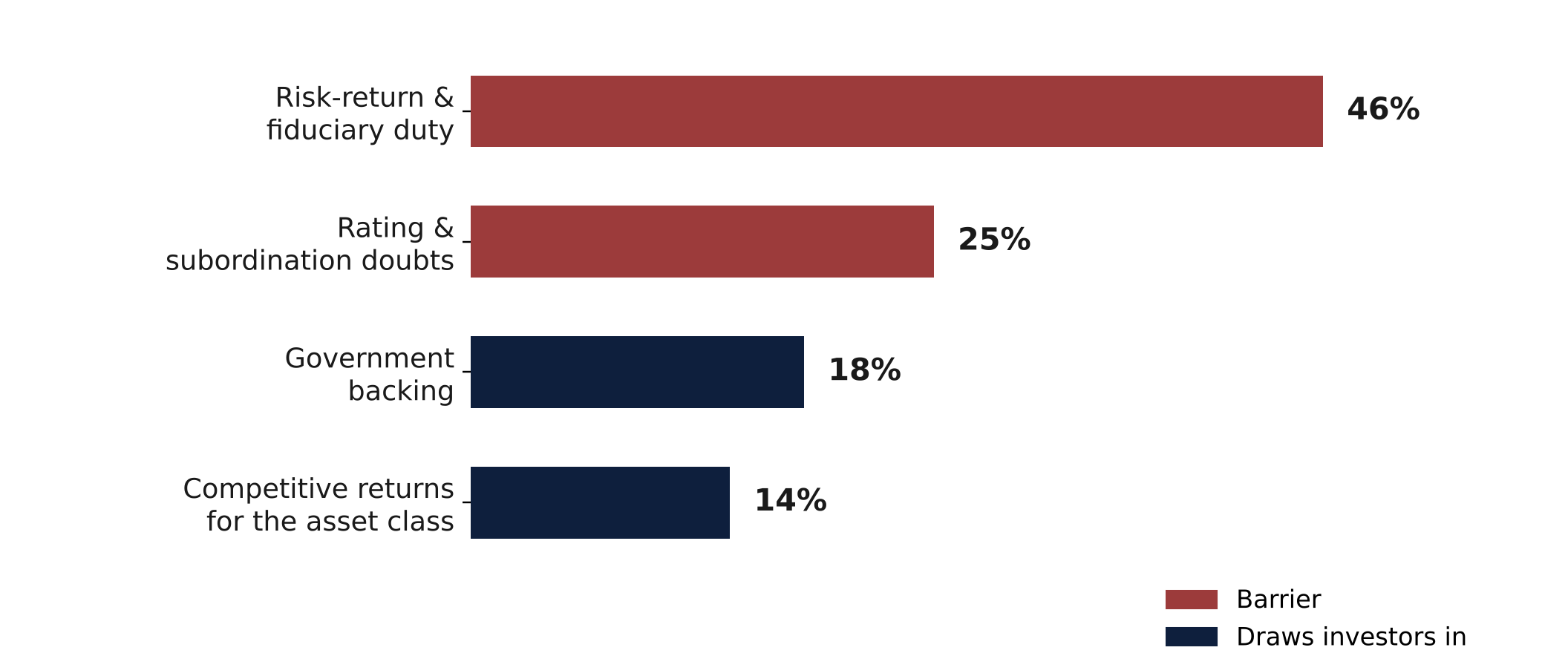
Source: author's own elaboration, based on interview data.
If fiduciary duty sets the ceiling on what private capital can accept, de-risking is what decides whether the TFFF comes close to it. This is precisely the gap the TFFF's blended structure is designed to close, and it is the best-received feature of the whole facility. Among those who took a clear position, 80% of intermediaries were positive, more than on any other theme examined in this research, and 33% of asset owners agreed. A junior tranche that absorbs first losses is a familiar, credible way to make an unfamiliar asset investable, and several respondents saw it as a plausible answer to shrinking aid budgets at a moment when grant-based conservation has struggled to scale.
The assumption was that you couldn't scale this up with grants, and you wouldn't have enough countries being willing to give grants. So, you try to mobilise private financing, which allows you to scale this up. It's hard to sustain with just public money because there's so much opposition now. - Asset Owner No. 001
A key limitation here is sample coverage. Only 11 of the 14 private investors discussed the blended structure at all, and just 8 took a position clear enough to code with confidence. Even so, their overall sentiment on this theme was more positive than on any other examined in this research.
Where almost everyone agrees
The one dimension where that divide disappears is governance. Only 3 of the 28 people I interviewed expressed confidence in the TFFF's current governance and risk arrangements, and none of them was an asset owner or an intermediary. Even the MDB-affiliated experts, the most consistently positive group in the whole sample, turned cautious here.
There are mainly two concerns. Payments reach eligible countries with considerable discretion over how the money is spent, which private investors read less as legitimate national ownership and more as a gap they cannot verify or trace.
It's their asset, it's their country, and I totally understand that. But people who are supplying the funds want to know what's happening with the funds. And because they're supplying the money, they deserve a little bit of control over how the money is being used […] I am investing the retirement funds of, you know, many, many people. So, I have responsibility to them as well. - Intermediary No. 005
The second governance concern is more structural. Because forests sit last in the payment waterfall, a weak year in capital markets reduces what countries receive, regardless of how much deforestation they actually prevented. That is a genuinely new kind of risk in results-based forest finance; REDD+ and the Amazon Fund never made a delivered conservation outcome conditional on bond market performance. The volatility also threatens the mechanism's own credibility, a concern raised even by interviewees otherwise favourable towards the TFFF.
Read together, this may be the most actionable finding in the whole study. Because the mechanism's operational guidance is still being designed, a single, well-targeted change to how payments are tracked and verified could move every stakeholder group's perception at once.
Where the design can still move
Three directions emerge from these findings. First, governance offers the highest-leverage fix available. Clearer, independently verifiable tracking of how payments are used would address the accountability concern and the reputational one in the same move.
Second, the payment waterfall is worth revisiting with investors in the room, not as a late concession but as a continuation of a conversation that is already under way. Realistic rather than optimistic projections about pricing and subordination are more likely to build the confidence this research found missing.
Third, intermediaries, who were consistently more open to the mechanism than the asset owners who ultimately allocate the capital, may be a more effective entry point for building market confidence than a direct pitch to institutional investors.
Part of the TFFF's challenge is the scale of its own ambition. Moving climate finance from a world run on aid budgets to one where private capital plays a real part in protecting nature is never going to be easy. The Rotterdam Statement is one early sign that private actors are willing to help shape that mechanism rather than simply wait for it to arrive fully formed. The TFFF is still being shaped, with operations due to start in 2027. Every structural concern raised in these interviews is a parameter still open for revision. The experience of the Green Climate Fund and the Amazon Fund suggests that a mechanism's early operational years shape its longer-term trajectory, and the perceptions documented in this research can help inform how the TFFF's design evolves from here.
No door is closed and no barrier is permanent while a mechanism like this is still being built. This research was an attempt to listen carefully to the piece of the puzzle that matters most for whether the TFFF succeeds: the people who would actually have to finance it.
Acknowledgements
Thanks to the 28 asset owners, intermediaries and experts who gave their time and expertise to this research, and to my supervisors, Professor Sam Fankhauser and Dr Abrar Chaudhury, for their guidance throughout my dissertation process.
Community Insights series
The Smith School's Community Insights series features up-to-the-minute and incisive commentary from leading voices outside of academia, including from our Board, business fellows and partners.
Juliana Santos Oliveira is an Economist with an MSc in Sustainability, Enterprise and the Environment from the Smith School of Enterprise and the Environment, and a Weidenfeld-Hoffmann Scholar. Her experience is in capital markets, strategic consulting, and philanthropy advisory. Her interest is in the intersection of private capital and social and environmental action.