
Looking backwards from a green bond: lessons from Tanzania's Zigi River Catchment
Community Insights series
The Smith School's Community Insights series features up-to-the-minute and incisive commentary from leading voices outside of academia, including from our Board, business fellows and partners.
Antrusha Leow is a sustainability professional with experience advising governments, multilateral agencies and businesses on climate finance, sustainability strategy and the energy transition in Southeast Asia. Previously a sustainability consultant at PwC Singapore, she is currently an MSc student in Sustainability, Enterprise and the Environment at Oxford's Smith School, researching adaptation finance and exploring how capital can be mobilised for renewable energy and climate adaptation.
One of the greatest privileges of studying at the Smith School of Enterprise and the Environment is the opportunity to test ideas beyond the classroom. For my MSc dissertation, that meant travelling to Tanzania to study East Africa's first subnational green bond, a TZS 53.1 billion issuance by the Tanga Urban Water Supply and Sanitation Authority (Tanga UWASA), and asking how subnational public entities, such as local authorities and public utilities, can access capital markets to finance climate adaptation in emerging markets.
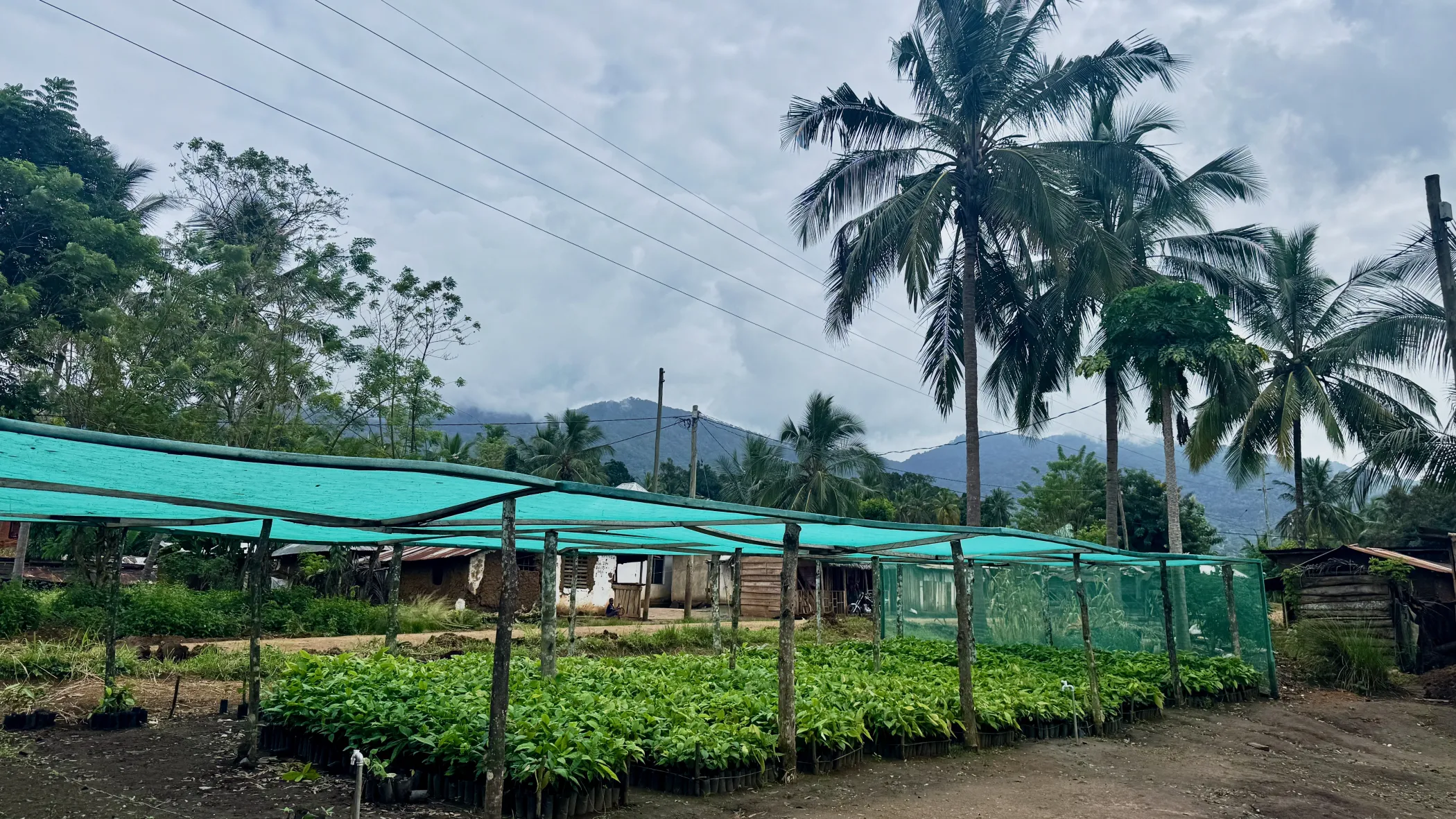
Part of the bond's proceeds is allocated to watershed conservation in the Zigi catchment. Tracing that investment upstream led me to UWAMAKIZI, a community organisation coordinating watershed conservation. Through Dr Iddi Mwanyoka at the University of Dodoma, whose early work laid the foundations for the Equitable Payment for Watershed Services (EPWS) programme, I spent a day with the association's leadership and members in Shembekeza Village.
Looking backwards from a green bond reveals a history that is largely invisible in discussions of sustainable finance. Long before the bond itself, relationships between upstream communities, downstream water users and public agencies had already been established through the EPWS programme. The significance of the green bond therefore lies not simply in the capital it mobilises, but in the way it builds upon a network of community organisations, public agencies and working relationships that had been evolving for well over a decade.
The Institutional Architecture of Conservation
UWAMAKIZI is a community-based organisation dedicated to protecting the Zigi River catchment. It emerged from the Equitable Payment for Watershed Services (EPWS) pilot launched in 2010 by WWF Tanzania and CARE International, and was formally registered in 2013 with 473 members across five villages. Today, it represents almost 3,000 members across 35 villages, illustrating how a donor-supported pilot transitioned into a sustained and locally-governed institution.
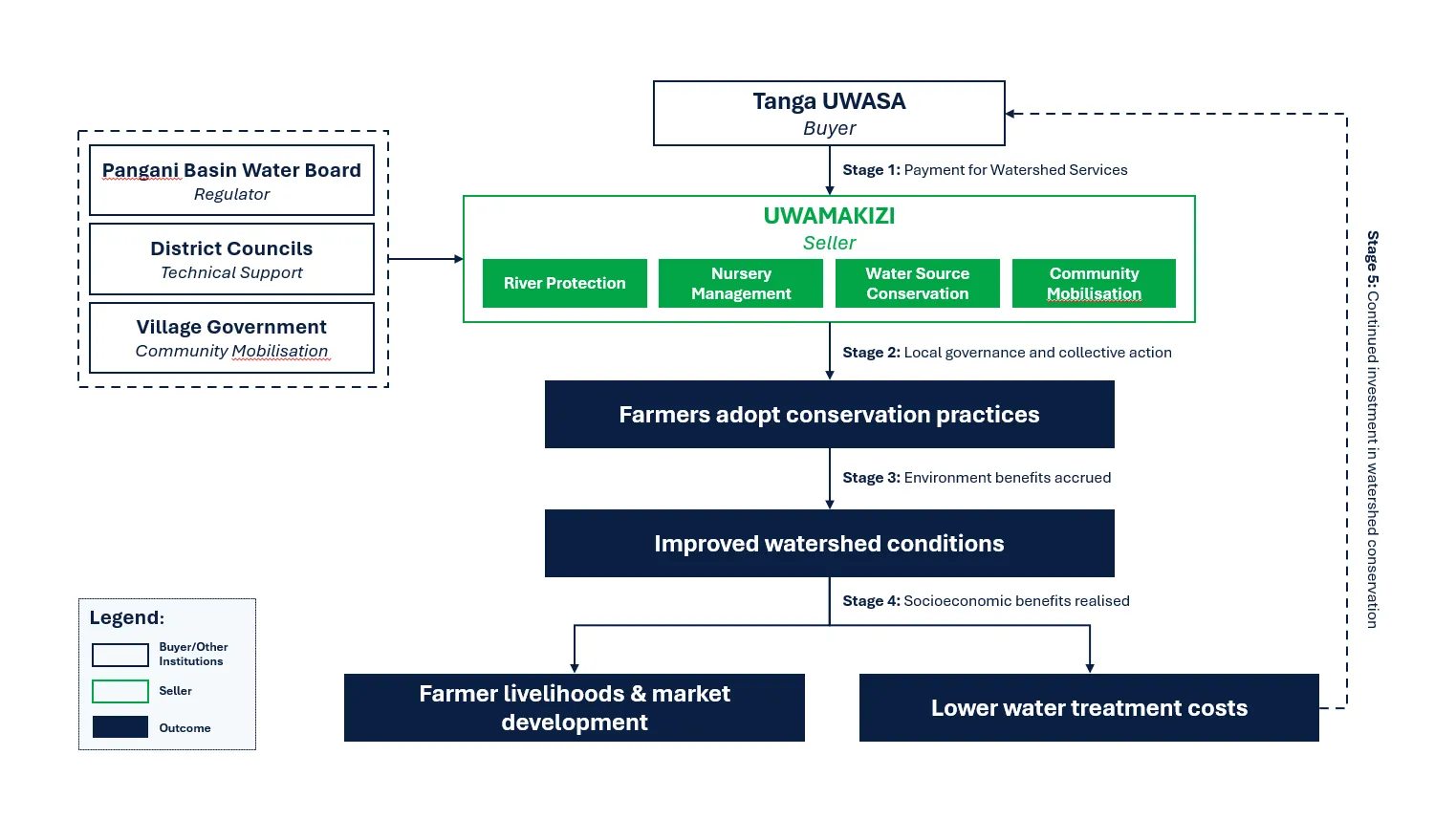
The EPWS model is often characterised as a payment between those who benefit from clean water downstream, and the communities managing watershed upstream. While accurate, this framing obscures much of what makes the arrangement durable. In practice, the scheme functions not merely as a financial transaction, but as a set of institutional relationships through which financial resources are translated into coordinated action across the catchment. In this case, Tanga UWASA acts as the downstream buyer of watershed services, paying for improvements in water quality, while UWAMAKIZI serves as the seller responsible for delivering those services through agreed land-use changes and watershed conservation activities. As the utility benefits from cleaner water and reduced sedimentation, Tanga UWASA has a direct economic incentive to invest in upstream watershed management that lowers its long-term water treatment costs.
At the village level, UWAMAKIZI coordinates implementation through four volunteer groups responsible for river protection, nursery and seedling management, water source conservation, and community mobilisation. Members receive priority access to seedlings, training in sustainable farming and river conservation, discounted livestock, and access to support services and community projects. Unlike many Payment for Ecosystem Services (PES) schemes that emphasise direct compensation, UWAMAKIZI's incentive structure relies largely on non-cash benefits that strengthen farmers' productive capacity and encourage long-term participation.
According to UWAMAKIZI, the programme has trained more than 1,000 farmers, established community nurseries, planted over 75,000 seedlings, restored nearly 18,000 trees along riverbanks and expanded tree cover across almost 186 acres. Farmers have also increasingly adopted perennial crops such as cocoa, cloves, cinnamon, avocado and citrus, reducing soil disturbance while diversifying household incomes.
Earlier evaluations, however, identified limited market access for higher-value perennial crops as a key constraint to sustained participation. It was therefore encouraging to learn during my visit that efforts to address the market-access constraint are now emerging - members described growing collaboration with the local government to strengthen cocoa sales, including early efforts to connect producers with buyers nationwide through a digital auction platform. While these developments remain nascent, they suggest that the EPWS model has continued to evolve beyond environmental payments alone, increasingly incorporating market development alongside watershed conservation.
Perhaps more revealing than any individual metric is the programme's longevity. Fifteen years after the original EPWS pilot, conservation has become embedded within Tanga UWASA's broader financing strategy. Its recent green bond allocates approximately TZS 525 million (around 1% of proceeds) to marking and protecting the boundaries around the Mabayani Dam, and expanding conservation activities in the UWAMAKIZI project area, while partners including The Nature Conservancy are now developing a Tanga Water Fund to attract additional long-term investment from a wider coalition of public, private and philanthropic actors.
Taken together, these features suggest that the EPWS model supports considerably more than watershed restoration alone. The annual payment from Tanga UWASA supports an organisation capable of coordinating conservation across dozens of villages, while linking participating farmers with technical support, local government and, increasingly, market opportunities. Rather than paying for individual conservation actions in isolation, the arrangement finances the institutional capacity through which those actions are organised, coordinated and sustained over time.
Looking Beyond the Instruments
Much of the debate around conservation finance understandably focuses on new financial instruments. Biodiversity credits, carbon markets, resilience bonds and blended finance all seek to mobilise additional capital and expand investment in nature.
Yet looking backwards from the Tanga Water Green Bond suggests that understanding the instrument itself is only part of a much longer story. Equally important is the institutional landscape into which that finance is introduced – the organisations, partnerships and governance arrangements through which capital is translated into conservation outcomes. The challenge, therefore, is not simply how to mobilise additional finance, but what that finance is being asked to build upon, and whether the organisations and relationships needed to put it to work are already in place or still need to be developed.
Acknowledgements
I would like to express my sincere gratitude to the leadership and members of Tanga UWASA and UWAMAKIZI for welcoming me and generously sharing their time and experience. I am also grateful to the Smith School of Enterprise and the Environment, and to Tropical Agriculture Association International, for their generous funding which made this fieldwork possible.
Community Insights series
The Smith School's Community Insights series features up-to-the-minute and incisive commentary from leading voices outside of academia, including from our Board, business fellows and partners.
Antrusha Leow is a sustainability professional with experience advising governments, multilateral agencies and businesses on climate finance, sustainability strategy and the energy transition in Southeast Asia. Previously a sustainability consultant at PwC Singapore, she is currently an MSc student in Sustainability, Enterprise and the Environment at Oxford's Smith School, researching adaptation finance and exploring how capital can be mobilised for renewable energy and climate adaptation.