
Schools in a warming India: rethinking heat readiness beyond emergency response
India experiences its hot season typically during April-June. However, this year, several cities experienced temperatures above normal as early as in mid-February. This followed last year’s pattern where heatwave conditions were recorded in February itself. This is becoming increasingly consistent with broader climate trends. Across South Asia, extreme heat events are not just becoming more frequent and intense but are also arriving earlier and lasting longer. What used to be an anomaly, is now shifting towards a seasonal pattern.
The impact of increasing heat stress is unfolding in several direct and indirect ways, with almost half of the world population projected to be living with extreme heat by 2050, according to Smith School research. India will have one of the largest populations to be impacted by the rising temperatures. On the other hand, India has been implementing significant policy initiatives such as city/state-level Heat Action Plans to manage extreme heat with early warning systems, responsive healthcare and cooling strategies.
However, the education sector continues to remain at the margins of this governance framework. This becomes more evident in how schools are responding by treating heat as a short-term disruption. Across states, schools have begun adjusting timings, advancing summer vacations, cancelling assemblies, and introducing water bells/breaks during school hours. However, these responses remain primarily reactive. They assume that learning environments can temporarily adjust to manage heat instead of being prepared to operate with it.
And this distinction is quite critical.
The challenge is not just rising temperatures but the misalignment between climate realities and the capacity of schooling systems. In much of India, school infrastructure, particularly government schools, were not designed with sustained heat exposure in mind. Concrete buildings that absorb and retain heat, metal or asbestos roofing, poor ventilation, and inadequate shading are a common feature. In many cases, access to water and electricity is still unreliable.
In addition to these challenges, overcrowding in classrooms compounds the risk of overheating. As per the legal requirements, the recommended teacher-student ratio should be under 30. However, actual student density in many urban and rural schools is often significantly higher, leading to increased thermal discomfort.
There is emerging evidence that suggests that such conditions are not just uncomfortable but also have adverse impacts on children’s cognitive performance and their learning outcomes. Studies across different contexts have found measurable declines in student performance with rising temperature. Accordingly, heat is now causing an educational crisis as well.
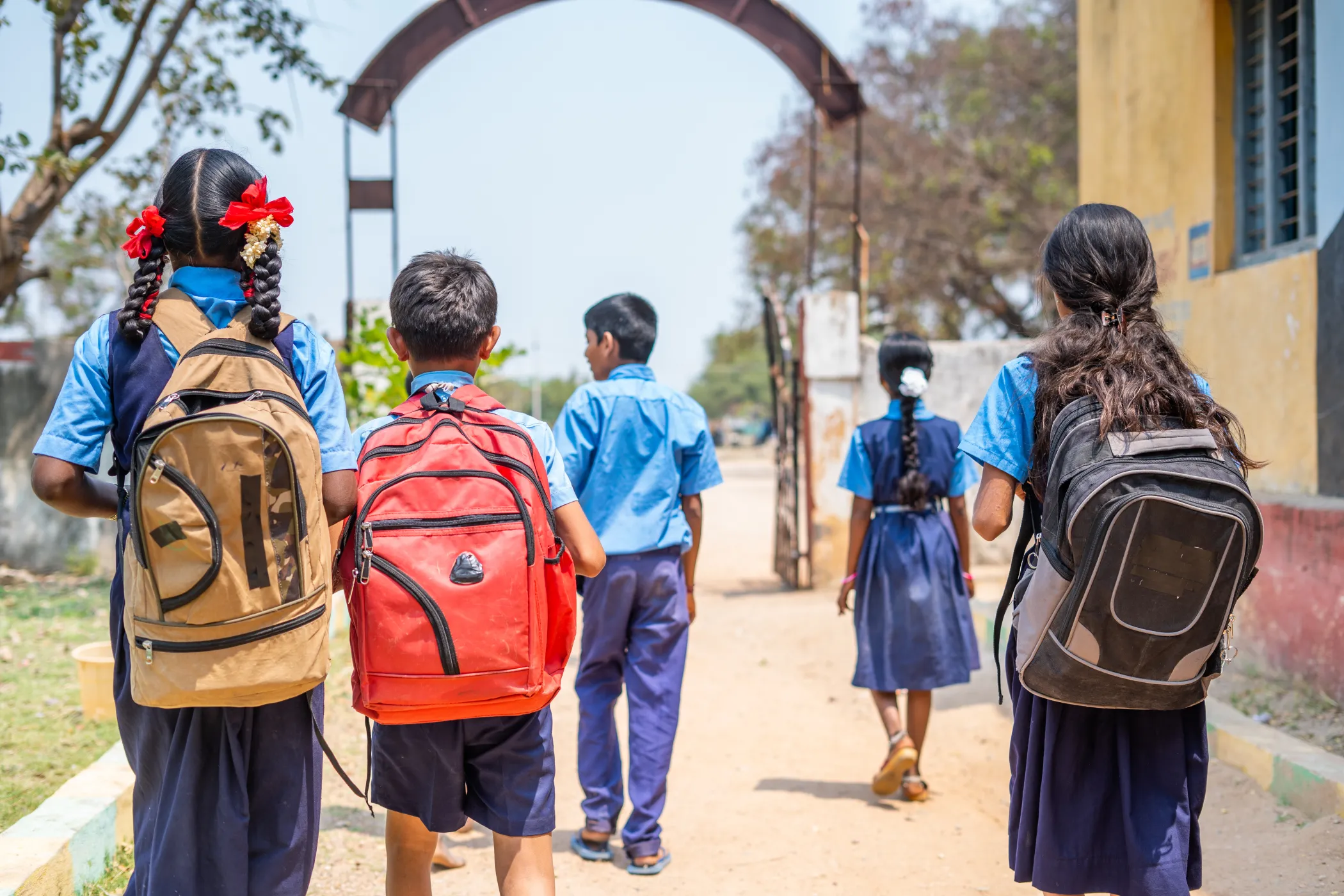
However, these effects are not evenly distributed. Children from higher-income households are buffered through access to air-conditioned classrooms and households and private transport. Whereas, for children belonging to low-income urban and peri-urban households, exposure to heat accumulates. Children often walk long distances to schools, spend hours in heat-stressed classrooms, and return to households that offer no escape. Overall, this creates differences in the conditions in which most students in India learn.
As students are unevenly exposed to heat, climate change risks deepening existing educational inequalities, reflecting a broader pattern that climate change disproportionately affects vulnerable populations, further reinforcing existing socio-economic inequalities.
Despite this growing tension, the inclusion of education into climate adaptation continues to be limited, especially in the design and delivery of the Heat Action Plans. This local heat management framework still engages with schools through short-term measures such as time changes, closures, ORS availability and awareness campaigns. While these are necessary, they do not address the structural dimensions of heat exposure in schools and hence, remain largely reactive. This also highlights a wider fragmentation in climate policy as adaptation is approached through disaster management or urban governance, while the education sector operates in its own governance silo. As a result, we see schools primarily as sites requiring quick responses rather than as critical assets requiring long-term adaptation.
However, by reframing schools as climate-resilient infrastructure, we might have a different set of policy possibilities.
First, there is growing evidence suggesting that passive cooling strategies can help reduce indoor temperature in resource-constrained systems. Interventions such as reflective roofing/cool roofs, building envelopes, improved cross-ventilation, and increased vegetation cover have demonstrated positive impacts in mitigating heat risk. States and cities like Tamil Naidu and Ahmedabad have started implementing cool roof programmes, indicating that such solutions are feasible and scalable.
Secondly, public financing mechanisms need to align with adaptation priorities. Currently, heatwave is not nationally recognised as a disaster hence, is not eligible for funding. However, a state can notify an ‘event’ as a disaster if it considers to be one, subject to certain conditions, to use up to 10% of the allocated disaster fund. There is a growing push for recognising heatwaves as a disaster as atleast 11 states have notified it, and the 2026-27 Finance Commission report also recommended its inclusion in the national list. In doing so, a state can access necessary funds that can be used for school retrofitting in high-risk areas.
Thirdly, there is a need for more granular data on school-level heat exposure and vulnerability. Within a city itself, not all schools face the same degree of risk. Spatial variation in temperatures, building materials and design, vegetation, built-up, student density, and reliable access to electricity and water will create uneven exposures. Without identifying which schools are in high-risk areas, interventions are likely to be broad and insufficiently targeted.
Finally, addressing these challenges requires multi-level and multi-scale coordination. Integrating climate hazards in education planning and vice versa requires collaboration across sectors that are currently at each other’s periphery. There is a need for a governance shift to address not just heat stress but to also bridge the educational inequalities exacerbated by it.
As long as we treat heat as an intermittent shock that surprises us each year, responses will continue to be short-term adjustments. We need to recognise rising temperature as part of India’s climate reality that demands a systemic approach to policy design. It is no longer about how schools respond to heat days but whether they are physically, institutionally and systemically prepared to operate within such a warming climate.
About the author

Ashima Gulati is a lawyer by training and a policy consultant with over eight years of experience in India’s public policy sector, working at the intersection of education, healthcare, and climate change to improve the well-being of marginalised communities. She is currently pursuing the MSc in Sustainability, Enterprise and the Environment at the Smith School of Enterprise and the Environment as an Indira Gandhi Scholar at the Oxford India Centre for Sustainable Development. Previously, she has completed her Master of Public Policy from the Blavatnik School of Government, University of Oxford.