
Reimagining the Ocean: The living system at the centre of enterprise
Community Insights series
The Smith School's Community Insights series features up-to-the-minute and incisive commentary from leading voices outside of academia, including from our Board, business fellows and partners.

Camila Llinás Restrepo is an environmental lawyer with experience in nature conservation, corporate compliance, and sustainability strategy in Colombia. With a growing focus on oceans, she is currently an MSc student in Sustainability, Enterprise and the Environment at Oxford's Smith School, researching blue finance and marine conservation in Latin America.
World Oceans Day 2026 asks us to reimagine our relationship with the ocean. The reimagination is already underway: in new legal frameworks, in regenerative blue economy models, in the emergence of blue finance, and in the generational knowledge of communities in lifelong reciprocal relationships with the ocean. The question is whether it will remain as a shift within the ocean sector, or reach all of enterprise.
THE PLANET IS BLUE
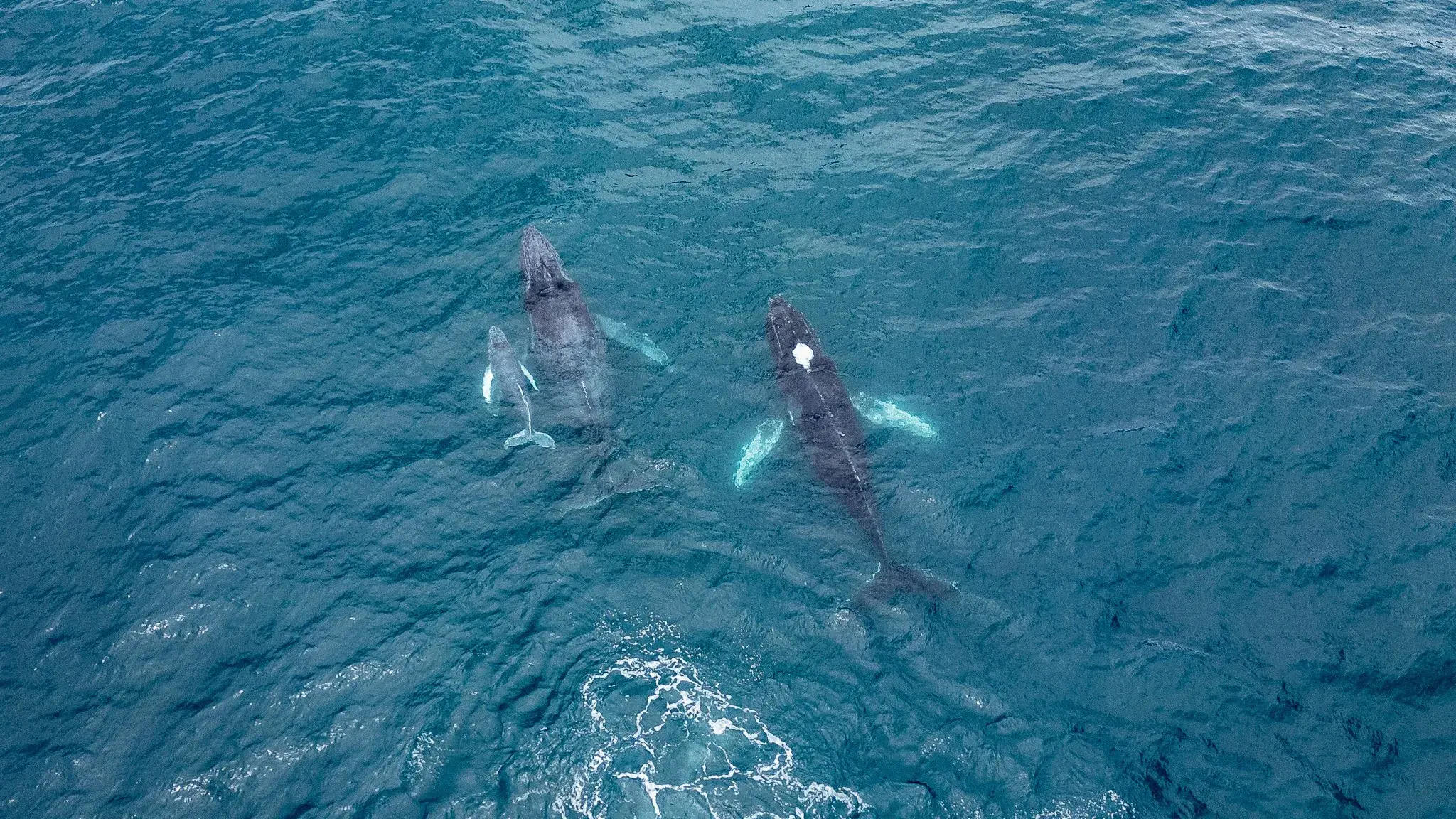
Somewhere in the South Pacific, a humpback whale is teaching her calf to breach. She travels from the warm breeding waters off Colombia and Ecuador - where her arrival sustains nature-based tourism for communities like those in Bahía Solano - southward toward Antarctic feeding grounds. Most species in the water surrounding her are yet to be discovered. Undersea cables carry roughly 90% of global telecommunications traffic. Container ships transport around 80% of global trade in goods by volume. Along the coastlines to her east, nations are exploring offshore wind to power their energy transitions. Meanwhile, fisheries sustain the food security and livelihoods of 3 billion people.
She swims through a world in transformation, a system on which we all depend. She adapts. She teaches.
Yet the very waters where she lives and where all this activity unfolds are still often spoken of as distant and peripheral, as something for ocean sectors and marine specialists to worry about. They are not. The ocean is the living system upon which planetary equilibrium (ecological, economic, and social) depends. It is a central operating system of the global economy, and simultaneously one of the least understood domains on Earth. World Oceans Day 2026 asks us to close that distance, “to move from passive inheritors of the ocean's generosity to active guardians of its future”. What does that mean for enterprise?
WE UNDERSTAND. AND YET.
We understand the ocean's role in planetary equilibrium. It produces approximately half the oxygen we breathe, has absorbed around 30% of anthropogenic carbon dioxide emissions, and has captured around 90% of the excess heat generated within the Earth system. Nearly 40% of humanity lives within 100 kilometres of its coast. Its ecosystems support extraordinary biodiversity, much of it still undiscovered, while providing food security, livelihoods, coastal protection, and cultural identity for billions of people.
We understand the pressures it faces. Pollution, biodiversity loss, and climate change are degrading marine ecosystems and increasing risks to coastal communities, food security, livelihoods, and economic stability.
And we understand what is at stake. The blue economy is projected to surpass $3 trillion annually by 2030. The ocean will be central to future energy systems, food security, climate adaptation, trade, innovation, and scientific discovery. It is not only a source of future opportunity, but the living system that already provides many of the conditions that make human life and economic activity possible.
And yet SDG 14 - Life Below Water - remains one of the most underfunded of all 17 Sustainable Development Goals. Achieving its objectives, including a sustainable blue economy and effective marine conservation, requires an estimated $175 billion annually. In contrast, only around $30 billion was disbursed between 2010 and 2025, largely through official development assistance and philanthropy.
Although the ocean remains one of the least explored systems on Earth, the gap between knowledge and action is not just a problem of exploration. It is a problem of perspective too. For many stakeholders, the ocean has long been understood as peripheral: a resource managed by marine specialists and largely absent from the conversations where investment decisions, business strategies, and governance frameworks are shaped. Unless a decision is explicitly coastal or marine, the ocean is rarely in the room. That is why reimagining the ocean begins with changing the premise from which those decisions are made.
This shift is already underway. The BBNJ Agreement, which entered into force on 17 January 2026 as the first legally binding treaty governing the high seas, shifted the legal premise: from the ocean as open space to the ocean as shared system where access carries obligation. Regenerative blue economy frameworks are redefining success away from volume and toward ecosystem and community health. Blue finance is emerging as a distinct field, backed by impact investors, philanthropists, and development banks. And the knowledge of coastal communities and indigenous peoples - long held, long practised - is beginning to inform formal governance and business models.
These movements share a common direction. The question is whether enterprise – all of it, not just ocean industry - will move with them deliberately to reimagine its relation to the seas.
A DIFFERENT PREMISE
The ocean is not a resource within a portfolio. It is the living system that supports and connects the systems on which every portfolio depends.
This is not a metaphor. The ocean is a living system within which physical, institutional, economic, and social systems interact and co-evolve. It shapes the hydrological cycles that influence weather patterns far inland, underpins food systems, trade, and energy transitions, and sustains cultures, identities, and livelihoods around the world.
Climate, food, trade, energy, biodiversity, and security are often treated as separate systems. In reality, many of them are embedded within ocean systems, with the seas acting as the hub through which they connect. It regulates many of the conditions that make human societies and economies possible, including climate, weather, rainfall, and temperature.
A coffee producer in the Colombian mountains may never operate near the ocean, yet ocean temperatures influence the rainfall patterns that determine harvests, global shipping routes move its product to market, and marine ecosystems help regulate the climate stability on which its business depends.
This is the reimagination World Oceans Day 2026 points toward. The ocean moves from the periphery to the centre, not as another sector to prioritise, but as a foundational system that regulates and connects many of the systems on which societies and economies depend. The shift is not simply in how we manage the ocean. It is in where we place it within our understanding of value, risk, resilience, and development.
This complexity calls for a different way of thinking. For enterprise, it shifts the question from “should I care about the ocean?” to “how am I already in relationship with it?” For finance, it changes the allocation logic: if the ocean is a sector, one funds ocean projects; if it is the system, one asks whether every investment is ocean-aligned. For nature conservation, success is not just measured by areas covered, but by whether they are translated into functioning, funded, and enduring projects.
WHAT IT WOULD LOOK LIKE
With the ocean at the centre, the relationship between enterprise and the seas begins to look different. It starts with five questions that can reshape how a business creates value, manages risk, allocates capital, innovates, and contributes to oceans regeneration.
Where does my business sit within ocean systems? If the ocean is the global system, every business depends on it, not only marine businesses. Agriculture depends on rainfall patterns shaped by ocean temperatures. Energy depends on the weather systems the ocean regulates. Insurance depends on coastal stability. The first step is understanding where ocean systems enable operations, create value, and shape risk for each and every business model, even where no obvious connection exists.
How do those connections shape decisions in my business model? Once the relationship between business and the ocean becomes visible, it can influence decision-making. The ocean moves from a peripheral concern to a foundational design principle, shaping how a business understands risk, creates value, allocates capital, and plans for long-term resilience. Ocean health becomes embedded in strategy, investment, and performance. In this way, the ocean shifts from a sustainability disclosure to a structural variable within the business model. The question is no longer whether a business is directly connected to the ocean, but how it manages and regenerates the system on which it depends. Coastlines, marine biodiversity, and the high seas move from externalities to shared assets whose long-term health becomes inseparable from long-term business performance.
What role does marine biodiversity play? Once the ocean system begins to shape business decisions, marine biodiversity takes on a different role - no longer a conservation concern of the ocean sector alone, but a shared asset and a source of knowledge. Species and ecosystems that have evolved over millions of years hold lessons in adaptation, resilience, and regeneration that no technology has replicated. The humpback whale is not only part of a conservation agenda, she is part of a living system from which enterprise can learn. Commitments such as 30x30 become relevant far beyond marine industries: the question is no longer whether protected areas exist on paper, but whether they remain funded, operational, and capable of sustaining ecosystems over time.
How is knowledge co-created? Understanding ocean systems requires bringing different forms of knowledge together. Coastal communities, Indigenous peoples, and Small Island nations hold generations of experience living within those systems. The shift is from consultation to co-creation: communities become partners in research, innovation, governance, and value creation. Their knowledge is not an external input, but central to understand how ocean systems function, where risks emerge, and how opportunities can be developed within ecological realities. In this model, communities become co-producers of both knowledge and value. From this perspective, a business that ignores this knowledge would be working with an incomplete understanding of the systems on which its long-term resilience and prosperity depend.
How does enterprise regenerate what it depends on? The final question is how enterprise contributes to regenerating the system on which it depends. Blue finance is providing part of the architecture for this shift. More than a mechanism for financing isolated ocean projects, it is the set of rules, tools, trust, and incentives that enables capital to flow toward ocean-positive outcomes - drawing on instruments from philanthropic grants and concessional finance through to impact investment and blended structures - supported by emerging principles and frameworks from institutions including the IFC, UNEP, and WWF. For businesses and the wider economy alike, recentring the ocean means directing investment toward the projects, businesses, and institutions that restore and sustain ocean systems: financing resilience-building, restoration, innovation, and stewardship. In this way, investment flows from financing isolated activities toward financing the health of the living system that underpins economic activity.
Relationship reimagined: Taken together, these questions describe a different kind of enterprise. One that understands where it sits within ocean systems, integrates those dependencies into decision-making, values biodiversity as part of the infrastructure on which it depends, works with communities as partners in knowledge creation, and directs capital toward regeneration. Such a business may operate on the coast, in a city, or high in the mountains. What changes is not its location, but its understanding of the system that sustains the global economy. The ocean becomes neither a distant environmental concern nor a specialised sector, but a foundational variable of business design.
THE OCEAN AT THE CENTRE
The whale and her calf are still out there. The ecological, social, and economic equilibrium of the planet depends on their environment, which is also ours. One day, that calf will make the same migration from Antarctica to the waters of Colombia and Ecuador, and pass its culture to the next generation. The ocean it inherits, and the relationship we choose to build with it, will depend in part on the premise from which enterprise relates to the ocean today.
The ocean will continue to power food systems, trade, energy transitions, and economic development. New frontiers will continue to open. It holds opportunities we do not yet fully understand, from future energy systems to innovation inspired by biodiversity and genetic resources. The question is not whether these opportunities emerge, but from what premise they are pursued.
Will they proceed from a logic of distance, or from one of connection and regeneration? The answer will shape how the next chapter of ocean development unfolds. It will determine whether blue finance remains marginal or grows to support the scale of investment the ocean requires, and whether marine protection exists only on paper or becomes operational in practice.
It begins with a question every business can ask today: Where does my business sit within the ocean's living system? How does it depend on it? How does it affect it? And how does it reciprocate?
Community Insights series
The Smith School's Community Insights series features up-to-the-minute and incisive commentary from leading voices outside of academia, including from our Board, business fellows and partners.
Camila Llinás Restrepo is an environmental lawyer with experience in nature conservation, corporate compliance, and sustainability strategy in Colombia. With a growing focus on oceans, she is currently an MSc student in Sustainability, Enterprise and the Environment at Oxford's Smith School, researching blue finance and marine conservation in Latin America.